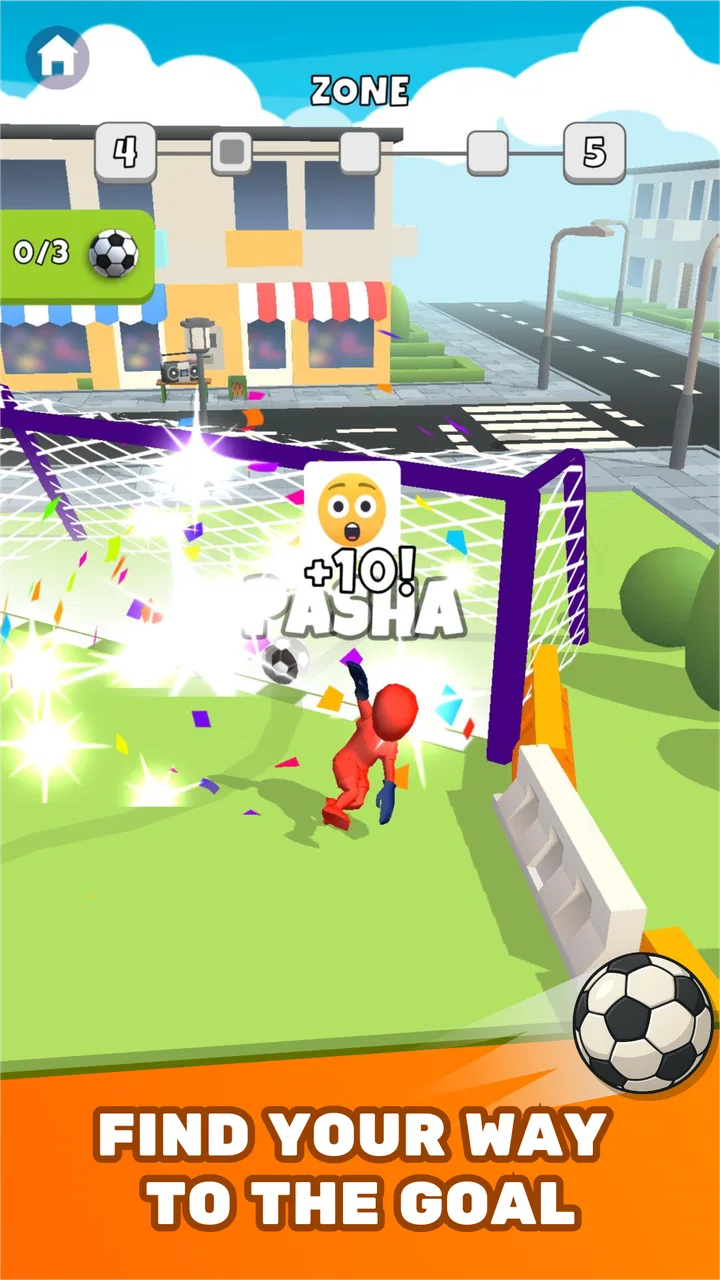
Crazy Kick! Fun Football game
- 4.5
- Rating
- 100.00M
- Installs
- Free
- Price

 Analysis by App-foxy
Crazy Kick is the kind of arcade football game I open when I want something immediate rather than a full sports simulation. I control a single ball, guide it through short attacking situations, and try to get past eleven opposing players before finishing the move. That simple setup makes it easy to understand within moments, but the changing pressure of each attempt gives the game more tension than its brief description suggests.
After spending time with it, I see the appeal clearly: this is football reduced to movement, timing, and a clean finish. There are no complicated team sheets to manage and no long match commitments to fit around a busy day. It is free to download, aimed at Everyone, and belongs firmly to the arcade side of mobile gaming. That makes it approachable, although players looking for realistic formations, licensed competitions, or deep career progression will want something else.
How the game feels when you play in short bursts
The first thing I noticed was how quickly a round gets going. The central action is easy to read: move the ball, avoid the defenders, and create enough space to shoot. This gives Crazy Kick a brisk rhythm without requiring me to memorize a large control scheme. It works particularly well when I have only a few minutes, such as while waiting for an appointment or taking a short break from work.
You May Also Like

 AccuWeather: Weather Radar
AccuWeather Review: A Quick, Clear Forecast for Everyday Decisions
For everyday plans, the best forecast is the one you can understand quickly. AccuWeather makes rain timing, radar, and local conditions easy to act on, with a few trade-offs.

 Hill Climb Racing
Why Hill Climb Racing Still Turns Crashes Into One More Run
A tiny car, a bumpy hill and one more upgrade: Hill Climb Racing keeps resurfacing because its simple chaos makes every near-miss feel personal.

 AliExpress - Shopping App
AliExpress Makes Global Shopping Feel Personal, but Shoppers Bear the Risk
AliExpress turns a global marketplace into a pocket-sized discovery engine. Its reach is useful, its shopping loop compelling, and its trade-offs easy to miss.

 Lords Mobile: Kingdom Wars
Lords Mobile Is a Kingdom-Building Routine, Not a Quick Match
A case-by-case verdict on the building, battles, device demands, and social commitments that make Lords Mobile rewarding for some players and exhausting for others.

 PDF Scanner app - TapScanner
TapScanner Makes Paperwork Easier to Capture, Check, and Share
TapScanner makes scanning with a phone feel less like a rescue operation and more like a dependable step in getting work done. Its capture tools are useful, though not flawless.

 Block Blast!
 Shows How Much a Puzzle Game Can Leave Out
A quiet grid game shows why puzzle players increasingly value instant clarity, repeatable skill and low-pressure play—and where the genre still needs to catch up.
More From Our News Desk
View All News


The speed is not only about how fast the ball travels. It comes from the need to make decisions before the defensive line closes in. A move that looks safe can become awkward if I drift too close to an opponent, while a direct route toward the goal may leave little room to correct my direction. I found myself alternating between quick reactions and small, deliberate adjustments instead of simply holding one direction and hoping for the best.
That balance is important because the game would become dull if every attempt were solved by moving straight ahead. The most satisfying moments came when I slowed down briefly, shaped a better angle, and then committed to the shot. My practical tip is to treat the approach to goal as part of the challenge, not as an empty space between defenders. A slightly wider route can make the final finish much easier.
The controls are best suited to players who enjoy direct input and immediate feedback. They do not ask me to coordinate a complete squad, select passing patterns, or manage stamina. Instead, the focus stays on the ball under pressure. That narrow focus is a strength for casual play, but it also means the experience may feel repetitive to someone who expects the variety of a conventional football game.
Why the short format works in everyday use
I can imagine using this game during a commute with an unpredictable schedule. If I have a few spare minutes, I can start an attempt without needing to remember a long storyline or prepare a team. If I am interrupted, the loss of progress is less frustrating than it would be in a longer match. This makes it a better fit for fragmented free time than a simulation that expects me to play through a complete fixture.
It is also suitable for younger players who understand the basic idea of football but may not want complicated menus. The Everyone age rating supports that broad accessibility. Still, accessible controls do not mean every situation is effortless. The challenge comes from judging movement and avoiding mistakes, so a child may need a little practice before the later actions feel comfortable.
One useful habit is to separate practice from score chasing. On an early attempt, I pay attention to how much room the defenders leave rather than forcing a shot immediately. Once I understand the movement, I try to improve the route. This approach makes failures more informative and reduces the temptation to repeat the same rushed action.
What happens during demanding play sessions
Crazy Kick is not a game that asks the phone to simulate a complete stadium, a large roster, or a long online match. Its focused arcade design suggests a lighter workload than visually ambitious sports titles, and in my use the appeal comes from quick interactions rather than elaborate presentation. That makes it a sensible choice for someone who wants football-themed play without committing to a large, feature-heavy package.
Even so, repeated attempts can feel more demanding for the player than the screen initially suggests. Quick restarts encourage me to keep trying, and that can turn a short session into a much longer one. The main resource being tested is my attention: after several failed approaches, I may start overcorrecting and making errors that were avoidable at the beginning.
For longer sessions, I recommend taking a brief pause after a few unsuccessful runs. The game’s simplicity can make every failure feel like it was caused by one small mistake, which encourages immediate repetition. A pause helps me return with a cleaner sense of direction instead of reacting emotionally to the previous attempt.
On the phone itself, the game’s compact arcade structure should be easier to accommodate than a full-scale football simulation, especially for people who prefer not to keep a large game installed. However, I would not treat that as a promise that every device will behave identically. Older hardware, limited free storage, background activity, and the condition of the operating system can all affect how comfortable any game feels in daily use.
Stability, interruptions, and getting back into play
What I value most here is the low barrier to returning. The game does not require me to reconstruct a complicated tactical plan every time I come back. I can focus on the next attacking sequence and quickly remember the basic rhythm. That is a meaningful advantage over games where an interruption leaves me unsure about objectives, controls, or team management.
For a game built around short attempts, recovery also means recovering from a mistake. A missed shot or poor approach does not need to ruin the whole evening. I can learn from the angle, restart my thinking, and try a different route. This makes the failure loop feel more approachable than in a long match where one error can affect many minutes of play.
There is a trade-off, though. Because the core interaction is so concentrated, technical or control friction would be especially noticeable. A player who expects a broad football package may interpret the repeated ball-focused action as a lack of content rather than a deliberate design choice. I recommend it to people who enjoy refining a small skill, not to those who need constant changes in mode or strategy.
The game comes from VOODOO, a developer associated here with a highly accessible arcade format. Its broad reach is reflected in an average rating of 4.6 from around 239 thousand ratings, while the game has passed 100 million installs. Those figures tell me that the basic concept has connected with a large audience, but they do not remove the personal question of whether this narrow style of play suits me.
Device requirements and practical expectations
The listed minimum operating system is Android 8.0, so compatibility is not aimed at extremely old Android releases. Anyone using a supported device should still consider the phone’s age and general condition. A newer system version alone does not guarantee a perfect experience if the device is already struggling with storage, heat, or many background processes.
I would be comfortable recommending it to someone who wants a relatively focused arcade game rather than a large football installation. It is free to start, which lowers the risk of trying it, but the presence of in-app purchases ranging from $0.99 to $69.99 per item means I would pay attention to purchase settings, especially on a shared device. The free entry point is useful, yet optional spending can become a consideration for families and for players who are prone to impulse purchases.
The current version is 2.40.2, and the game was released on August 30, 2019. That history matters mainly because this is not a brand-new experiment; it has had time to establish its identity as a compact arcade football experience. I would still keep the app updated through the normal store process when possible, since current software is generally the sensible starting point for compatibility and recovery.
Storage planning is another small but practical point. I would leave some free space before installing any game, even one whose main appeal is simplicity. A crowded phone can make updates and general use more troublesome. I also avoid starting a session when the device is already hot or when many other apps are active, because that is an easy way to make any mobile game feel less responsive.
Who will enjoy it, and who should skip it
This is a good match for players who like one-touch ideas with room for improvement. If you enjoy trying the same type of challenge repeatedly, adjusting your route, and chasing a cleaner finish, the focused design has enough immediacy to keep you engaged. It is also a strong option for casual players who want football flavor without learning an extensive control system.
I would be more cautious about recommending it to someone who wants a realistic match experience. There is no reason to approach it expecting the depth of a traditional football simulation, with full teams, tactical substitutions, and long-form competition. A conventional sports game is the better choice for that audience. Likewise, players who quickly lose interest when the main mechanic stays consistent may find the narrow scope limiting.
It is less suitable for people who dislike retry-based arcade play. The satisfaction comes from improving how I handle the ball and the defenders, not from discovering a large collection of unrelated activities. If repeating a compact challenge feels like work rather than fun, the game will probably not change that preference.
Small tactics that make attempts more consistent
My most useful adjustment was to stop treating every defender as something to pass at the last possible second. I try to read the available lane earlier and choose whether I want a safer curve or a more direct approach. This reduces frantic corrections near the goal, where a small mistake can ruin an otherwise good run.
I also found it useful to think about the final shot before reaching the last defender. If I arrive at the goal without a clear angle, I have already made the difficult part harder. Planning the finish early helps me preserve the space needed for a clean attempt rather than reacting only after the defense has closed around the ball.
Another practical trade-off is speed versus control. Moving aggressively can save time and feel exciting, but it leaves less room to correct direction. A calmer opening can create a better finishing position, even if it feels slower. I would use the faster approach when the lane is obvious and the controlled approach when the defenders are arranged to punish a straight run.
These habits are not complicated, but they give the game more depth than the basic premise suggests. The challenge is not just to reach the goal; it is to arrive with enough control to finish. That distinction is what kept the arcade loop from feeling completely automatic during my sessions.
How it compares with other arcade football choices
Compared with a full football simulator, Crazy Kick is far easier to pick up and far less demanding in terms of time and decision-making. I do not need to manage an entire squad or commit to a long match. The cost of that convenience is variety: a simulation offers more systems, while this game concentrates on one ball and one attacking idea.
Compared with a general endless runner, it has a clearer football identity and a more deliberate goal. The obstacles are not merely there to keep me moving; they shape how I approach a shot. On the other hand, an endless runner may offer more changing environments or broader progression, depending on the title. I would choose this game when I want the football theme to matter, even in a very simplified form.
Against management-focused football games, the difference is even sharper. Those alternatives reward planning rosters and long-term decisions, while this one rewards immediate control. Neither is universally better. I prefer Crazy Kick when I want a quick mental reset, and I would choose a management game when I want a slower project that develops over many sessions.
My performance verdict after using it
From a practical performance perspective, the game’s focused arcade presentation is a sensible fit for short mobile sessions. It does not present itself as a heavyweight football simulation, and its main appeal is quick interaction rather than a large collection of resource-intensive systems. I would still judge the experience on the individual phone, especially if the device is old, nearly full, or already under strain.
For reliability, its strongest quality is how quickly I can understand what to do again after an interruption or a failed attempt. That makes it forgiving as a casual companion. The main limitation is not complexity but repetition: the same concentrated style that makes it efficient also defines its ceiling. Players should know that they are choosing a focused arcade loop, not a complete football world.
The game is free and rated for Everyone, but I would keep the in-app purchase range in mind before handing it to a child or using it on a shared account. I would also make sure the phone meets Android 8.0 or later and has reasonable free space. Those simple checks are more useful than expecting a particular result from the title alone.
In the end, I recommend Crazy Kick to anyone who wants football-themed arcade action that can fit into spare moments and reward better timing. I would skip it if my priority were realistic matches, deep team management, or constant variety. For the right player, the best part is the combination of instant access and small, repeatable improvements: I can play quickly, notice where my approach failed, and try again with a smarter route.
FAQs for Crazy Kick! Fun Football game
01What is the objective of Crazy Kick! Fun Football game?
Crazy Kick! Fun Football is an engaging and casual soccer game where your primary goal is to navigate the ball past obstacles and opponents to score goals. The game emphasizes fun and creativity, allowing players to dribble, dodge, and shoot their way through various challenging levels.
02Can I play Crazy Kick! offline?
Yes, you can enjoy Crazy Kick! Fun Football without an internet connection. This makes it perfect for playing on the go, whether you're commuting or just in a spot without Wi-Fi. However, certain features like updates or in-game purchases may require a connection.
03Are there in-app purchases in Crazy Kick! Fun Football?
Crazy Kick! offers in-app purchases that enhance the gaming experience. You can buy items like new ball designs, player skins, and other customizations. While these purchases can enrich gameplay, they are optional, and you can still enjoy the game fully without spending money.
04Is Crazy Kick! suitable for children?
Crazy Kick! Fun Football is designed to be family-friendly and suitable for all ages. Its colorful graphics and simple controls make it accessible for children, while the increasing difficulty levels provide a challenge for adults. Parents can feel comfortable letting their kids play this entertaining game.
05What are the system requirements for Crazy Kick! on Android and iOS?
For Android devices, Crazy Kick! requires Android version 4.4 and up. For iOS users, the game is compatible with iOS 9.0 or later. It is optimized to run smoothly on most modern smartphones and tablets, ensuring a seamless gaming experience across different platforms.
Pros
- Intuitive controls make it easy to play.
- Bright graphics enhance the gaming experience.
- Quick matches for on-the-go fun.
- Minimal ads to keep gameplay smooth.
- Variety of levels keeps it engaging.
Cons
- Lacks multiplayer option for social play.
- Limited customization for character design.
- Repetitive music can become annoying.
- Occasional lag on older devices.
- In-app purchases can add up.

Crazy Kick! Fun Football game
Gallery